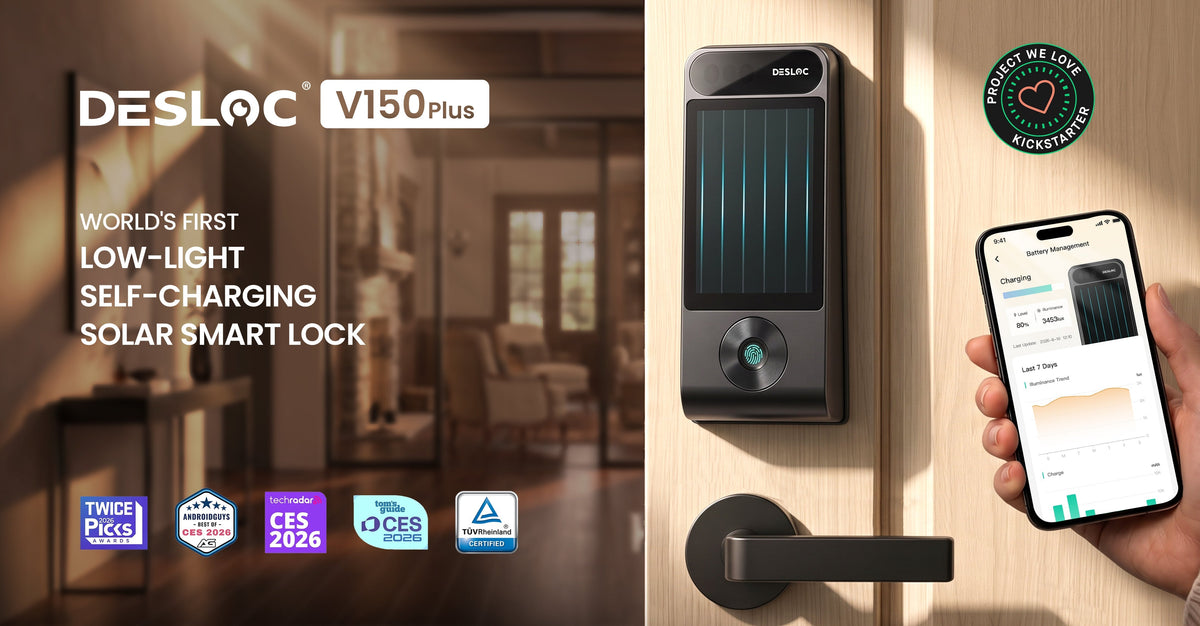
If your smart lock starts warning you about low batteries during a cold snap, you’re not imagining it. Cold weather can temporarily reduce the power a battery can deliver—right when the lock’s motor needs a quick burst of energy to move the deadbolt.
The good news: a warning does not automatically mean the lock is broken. A fresh set of the batteries recommended for your model, plus a quick check of the door and deadbolt, solves many winter power problems.
If you need to get inside right now
Try your backup key: Use the mechanical key that came with your lock, if your model includes one.
Use emergency power: If your model has an exterior USB-C port, connect a compatible power bank for temporary power.
Replace or recharge: Once inside, replace all AA batteries together or recharge the removable battery pack indoors.
*Important: An emergency USB-C port powers the lock long enough to unlock it. It does not recharge disposable AA batteries. Port location and backup options vary by model, so check your manual before winter arrives.
Why cold weather can trigger a low-battery warning
Batteries rely on chemical reactions to make electricity. When the temperature drops, those reactions slow down, and the battery has a harder time delivering power on demand. Think of cold maple syrup: it is still in the bottle, but it moves much more slowly.
A smart lock is especially sensitive to this because its motor needs a short, strong burst of power. Batteries that seemed fine yesterday may struggle on a very cold morning. After warming up, they may appear stronger again—but for a front-door lock, that rebound is not something to rely on.
Cold may be only part of the story: Winter can also make doors shift slightly. If the deadbolt rubs against the strike plate, the motor must work harder and uses more power. If you have to push or pull the door before the bolt moves smoothly, check the alignment instead of blaming the batteries alone.
A two-minute pre-winter check
- Confirm the recommended battery type in your model’s manual.
- If a low-power warning is showing, replace the full set of batteries.
- Test that the deadbolt moves smoothly with the door open and closed.
- Locate the mechanical key and emergency power port before you need them.
- Keep a suitable power bank somewhere you can reach from outside.
A little preparation now can spare your family a cold wait on the doorstep later.
Five simple ways to prevent a winter lockout
Replace weak batteries before the first deep freeze
Do not wait for a bitterly cold night. If the app or lock reports low power, install a fresh set of the battery type listed in your model’s manual.
Replace the full set at the same time
Use new batteries of the same brand and type. Mixing old and new batteries—or different chemistries—can lead to poor performance and increase the risk of leakage.
Make sure the deadbolt moves freely
With the door open, lock and unlock it a few times. Then repeat with the door closed. If it only struggles when closed, the door or strike plate may need adjustment.
Keep your backup outside the locked home
A power bank in the kitchen cannot help when you are standing on the porch. Keep a charged one in your everyday bag or with someone you trust, and avoid leaving it for long periods in a freezing car. Store a backup key somewhere secure and accessible, too.
Bring rechargeable packs indoors before charging
If your model uses a removable lithium-ion pack, let it warm to the charging temperature stated in the manual. Many lithium-ion batteries restrict charging below 32°F (0°C) to protect the cells.
Questions homeowners ask most
Should I use alkaline, lithium, or rechargeable AA batteries?
Use only the battery type listed for your exact lock model. AA batteries that look alike can have different voltages and discharge behavior. Do not assume that rechargeable NiMH or lithium AA batteries are compatible unless the manual specifically says they are.
The motor hums, but the deadbolt does not move. What should I check?
Start with a complete set of fresh, recommended batteries. Then test the lock with the door open. If the bolt moves normally while the door is open but struggles when it is closed, alignment or weather-related door movement is the more likely cause.
The warning disappeared after the batteries warmed up. Can I keep using them?
Cold batteries can recover some performance as they warm, but a front-door lock is not the place to stretch a questionable set. Replace the batteries in the lock and recycle the old ones according to local rules. Never mix a partly used battery back into a fresh set.
Why won’t my rechargeable battery pack charge outside?
The pack’s protection system may be limiting charging because it is too cold. Bring the removable pack indoors, let it reach the temperature range listed in the manual, and then charge it with the recommended cable and power source. Do not heat it with a hair dryer or place it on a radiator.
What should I do if I see white powder or corrosion?
Stop using the lock’s battery compartment until it is cleaned. Wear household gloves and eye protection, work in a ventilated area, and follow the battery manufacturer’s cleanup instructions. If the contacts are badly corroded or you are unsure what leaked, contact DESLOC Support rather than forcing in a new set.