

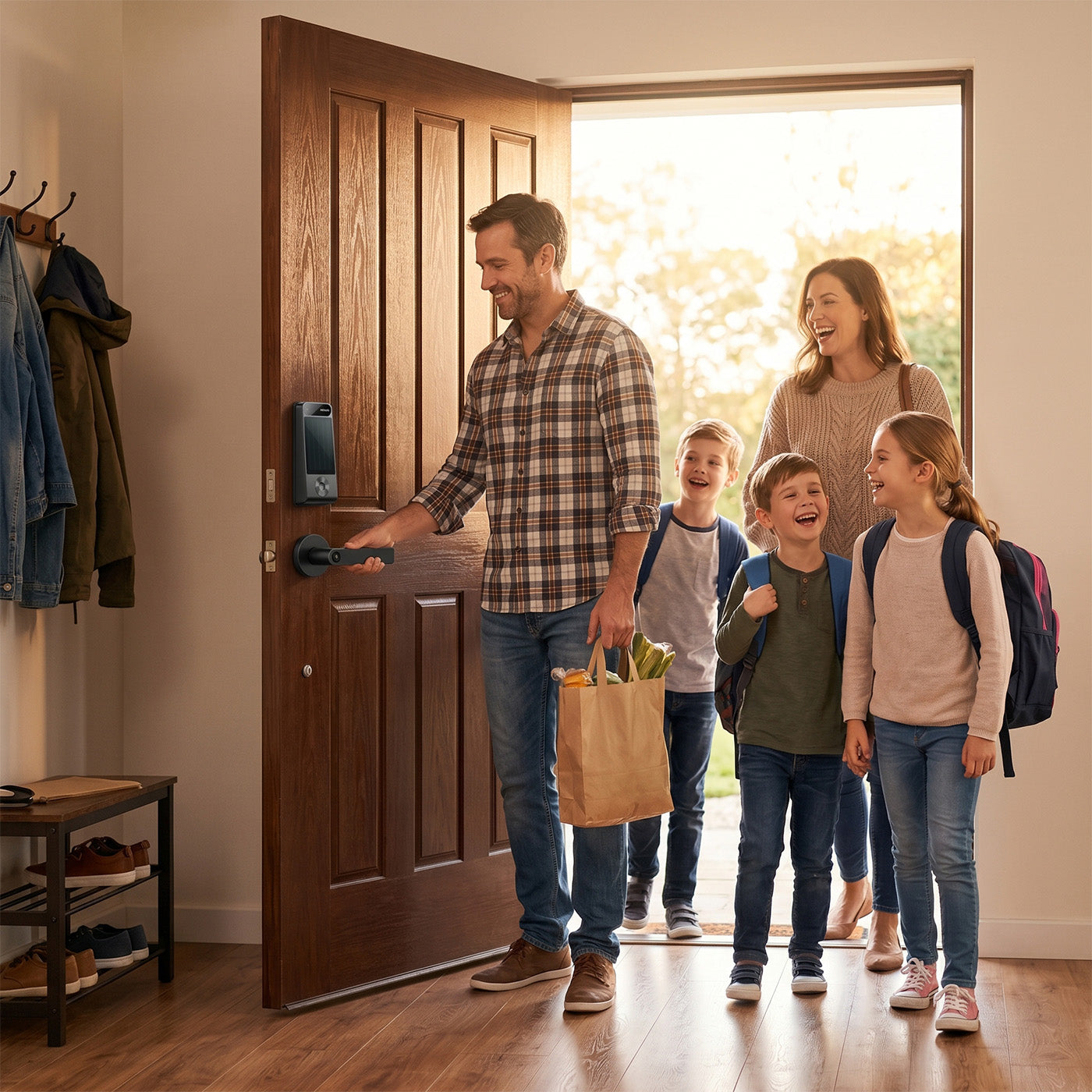
Choose 3D face recognition if hands-free entry is your priority. Choose palm vein recognition if you prefer an intentional, contactless gesture and do not want to use your face as the primary way in.
That is the short answer. The right fit also depends on who uses the door, how much direct sun reaches your porch, and how you want to manage charging.
The difference in everyday terms
Palm vein and face recognition both use biometric information, but the experience at the door is different.
Palm vein recognition uses near-infrared light to read the vein pattern beneath the skin of your palm. With the DESLOC K140 Plus, you raise your hand in front of the reader and hold it at the recommended position. It is contactless, but it is still a deliberate action.
3D face recognition uses infrared depth sensing to create a mathematical model of facial features. With the DESLOC V150 Plus, you approach the door in a natural standing position and the lock can recognize an enrolled face without requiring a hand gesture.
Palm vein vs. face recognition at a glance
| Decision factor | K140 Plus: Palm vein | V150 Plus: 3D face |
|---|---|---|
| Daily action | Raise and position your palm near the reader | Approach and face the lock naturally |
| Best fit | People who prefer intentional, contactless biometric entry | Busy households that value truly hands-free entry |
| Hands full | You still need to raise one hand | No hand gesture required |
| Night use | Near-infrared palm sensing; the lock may need to wake first | Infrared 3D recognition is designed for day or night |
| Environmental watch-out | Strong direct sunlight, reflections, distance, and palm angle can affect scanning | Stand within the recommended recognition range and face the lock naturally |
| Power approach | Rechargeable 10,000mAh battery | Rechargeable 10,000mAh battery plus low-light solar charging |
| Backup access | Passcode, DESLOC App, and mechanical key | Fingerprint, DESLOC App, and mechanical keys |
| Biometric privacy | Palm vein data stored locally on the lock | Face model and fingerprint data stored locally on the lock |
Choose palm vein recognition if...
- You want contactless biometric entry but prefer not to make face recognition your primary method.
- You like the clear intent of raising your palm before the door unlocks.
- Fingerprint readers are inconvenient because of worn fingerprints, gloves being removed, or frequent changes to fingertip condition.
- Your entry is covered or shaded rather than exposed to strong, direct sunlight.
- You are comfortable positioning your palm at the correct distance and angle.
The K140 Plus can automatically wake as someone approaches when Proximity Detection is enabled. DESLOC lets users adjust the sleep interval: a more responsive setting uses more standby power, while an energy-saving setting may take longer to wake. If the keypad is dark during a sleep cycle, touching it wakes the lock before palm vein scanning.
Check your porch light
Palm vein recognition is optical. DESLOC notes that strong direct sunlight and strong reflections can reduce recognition performance. A porch roof, overhang, or shade is helpful when the exterior reader would otherwise face prolonged direct sun.
Choose 3D face recognition if...
- You regularly arrive carrying groceries, packages, work bags, or a child.
- You want the front door to recognize household members without requiring them to reach for a sensor.
- Your household includes children, older adults, or people of different heights who would benefit from a natural standing-distance scan.
- You want biometric entry during the day and at night.
- Lower charging maintenance matters to you and your entry receives ambient light.
The V150 Plus uses infrared 3D depth sensing and liveness detection. DESLOC says it is designed to work with everyday changes such as glasses, hats, facial hair, and nighttime conditions. Its stated recognition height range is approximately 3 ft 7 in to 7 ft 6 in when installed at the recommended height, and the suggested standing distance is about 1.3 to 3.3 ft (0.4 to 1 meter).
Its other major difference is power: the integrated perovskite panel is designed to harvest energy from ambient light, including shaded porches and overcast conditions. The lock still includes a rechargeable battery, low-battery alerts, USB-C emergency power, and two mechanical backup keys.
Which is better for families?
For parents carrying children or bags
Face recognition is usually the more convenient interaction because it does not require a free hand. Walk up, pause naturally, and open the door.
For children
Face recognition may be easier because it does not require consistent palm positioning. Confirm that the child falls within the supported height range and completes enrollment in person.
For older adults
Either can be a good alternative to fingerprints that have become faint or worn. Face recognition asks for less hand movement; palm vein recognition may suit someone who prefers a deliberate hand gesture. The better choice depends on comfort, mobility, and the entry environment.
For guests, cleaners, and short-term access
Biometric enrollment is best reserved for regular household members. For temporary users, a PIN or app-managed access is usually easier to add and remove.
What about privacy and security?
The more useful question is not simply “Which biometric is more secure?” It is “How is the biometric implemented, stored, and backed up?”
DESLOC states that both models keep biometric data locally on the lock. Enrollment must be completed in person and cannot be performed remotely. On the V150 Plus, the infrared face system does not save a conventional photograph that can be viewed or exported; it creates a mathematical face model. Both product systems include liveness-related safeguards designed to help distinguish a real user from a copied representation.
Neither biometric should be your only plan
A dependable front door still needs backup access. Confirm where the mechanical key and emergency power connection are located before installation is complete, and make sure every household member knows their backup method.
The practical recommendation
Pick the K140 Plus if you want contactless biometric access with a deliberate palm gesture, your entry is reasonably shaded, and a conventional rechargeable-battery routine works for you.
Pick the V150 Plus if hands-free entry is the priority, your household includes people of different ages and heights, and you value low-light solar charging alongside face and fingerprint backup.
If you are still unsure, stand outside your door and replay your most common arrival: Are your hands usually full? Does direct afternoon sun hit the lock? Who needs to get in without help? The best technology is the one that fits that moment every day.
Frequently asked questions
Is palm vein recognition better than face recognition?
Not universally. Palm vein recognition is better for an intentional, contactless hand gesture. Face recognition is better for hands-free entry. Door conditions and household habits matter more than choosing the technology with the more futuristic name.
Does palm vein recognition work in direct sunlight?
Strong direct sunlight and reflections can interfere with the K140 Plus optical sensor. A shaded or covered entry is preferable. Keep a passcode, app access, or mechanical key available as backup.
Does V150 Plus face recognition work at night?
Yes. The V150 Plus uses infrared 3D recognition designed for daytime and nighttime use.
Can I enroll a palm or face remotely?
No. Enrollment must be completed in person at the lock. The DESLOC App can help manage users, but it cannot remotely capture a new palm or face.
Do these locks keep a photo of my face or palm?
DESLOC says biometric data is stored locally on the lock. For the V150 Plus, the infrared face system creates a mathematical model rather than a conventional photo that can be viewed or exported.
